What Does a Professional Business Mascot Project Include?
Plan a professional business mascot: strategy, character development, 2D or 3D production, animation, approvals, and usage requirements.
What you’ll take away.
- Give the character a business role first.
- A concept image is not a production-ready system.
- Agree on formats, applications, and usage terms.
Two visual guides to the key ideas.
Use the diagrams below, then continue into the practical guide.
From a business role to production
A production workflow. Stage order does not imply a promised timeline or an included deliverable.
The application determines the asset scope
A scope diagram for discussing the required deliverables. Final formats and rights are agreed for the project.
A mascot project should begin with what the character needs to do for the business. A friendly guide on a service website, a character in an animated commercial, and artwork for a physical costume can require very different production work.
1. Define the character's business role
Identify the audience, message, personality, and intended channels. Decide whether the character will teach, entertain, guide, or represent a particular service promise. Review how it will appear alongside your existing identity so it becomes a recognizable part of the brand.
2. Agree on concept exploration
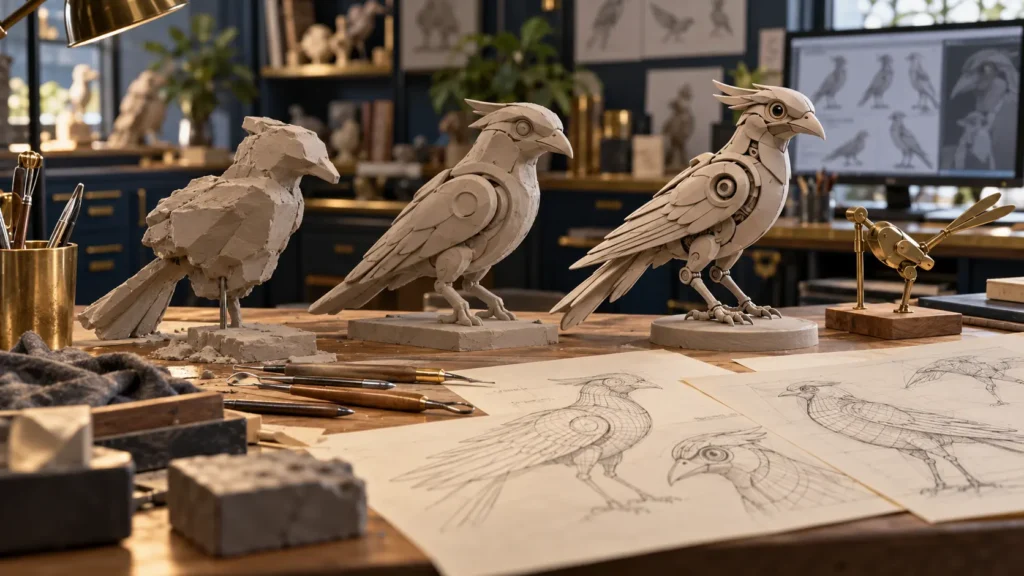
Concept work explores direction: silhouette, proportions, expressions, colors, clothing, and visual style. Define the number of directions and revision rounds in the scope. A single generated image or polished illustration is not automatically a complete character system.
3. Develop a repeatable character
A repeatable character needs consistent proportions and recognizable details. Depending on scope, reference sheets can document front, side, and rear views, expressions, poses, material choices, and usage rules. Consider how the character reads as a small icon as well as in a large campaign image.
4. Specify production requirements
| Intended use | Requirements to discuss |
|---|---|
| Website and social artwork | Poses, transparent backgrounds, crop-safe compositions, and export sizes |
| 3D renders | Model detail, materials, lighting, scene requirements, and deliverable formats |
| Animation | Rigging, movement range, facial performance, voice, sound, and shot planning |
| Print and large-format graphics | Resolution, color workflow, dimensions, and production checks |
| Physical products or costumes | Separate manufacturing assessment, materials, safety, specifications, and supplier capability |
Confirm what is included rather than assuming one deliverable is suitable for every use. Manufacturing is a separate production discipline and should be assessed before promising a physical result.
5. Clarify approvals and usage
Document which files are delivered, which uses are permitted, how third-party assets are handled, and when approvals occur. Ownership and licensing depend on the agreement and the material involved. Resolve those terms before commissioning production; a concept preview alone does not establish exclusivity.
How AI concept tools fit
An AI preview can help communicate an initial direction. It still requires review for consistency, suitability, originality concerns, and production feasibility. Explore the Mascot Lab overview with those limits in mind. Human-led mascot and character development defines the approved direction and execution scope.
Prepare a useful mascot brief
- Business, audience, and primary service.
- Character role and personality.
- Existing brand colors and visual references.
- Required channels, poses, and formats.
- Animation or manufacturing needs, if any.
- Timeline, decision-maker, and planned investment.
See how a character connects with a website and campaign in the Elf's Christmas Lights project breakdown. For production planning, explore 3D modeling and animation and film, or send Lion Crown Studios a brief.
| Stage | Ask to review | Approval question |
|---|---|---|
| Concept | Silhouette, personality, visual direction | Does it fit the audience and role? |
| Character system | Proportions, views, expressions, poses | Can it be reproduced consistently? |
| Production | Formats, model, rig, motion, print requirements | Does the scope support the real applications? |
Put it to work
List the first three places the mascot must appear, and define the file or production needs for each.
YOUR NEXT STEP